
August 24, 2026
Brass vs Aluminum Landscape Lighting Fixtures: What Survives a Cincinnati Winter?
Brass, copper, aluminum, or composite? What each fixture material costs in Cincinnati and which ones survive freeze-thaw, road salt, and wet mulch.
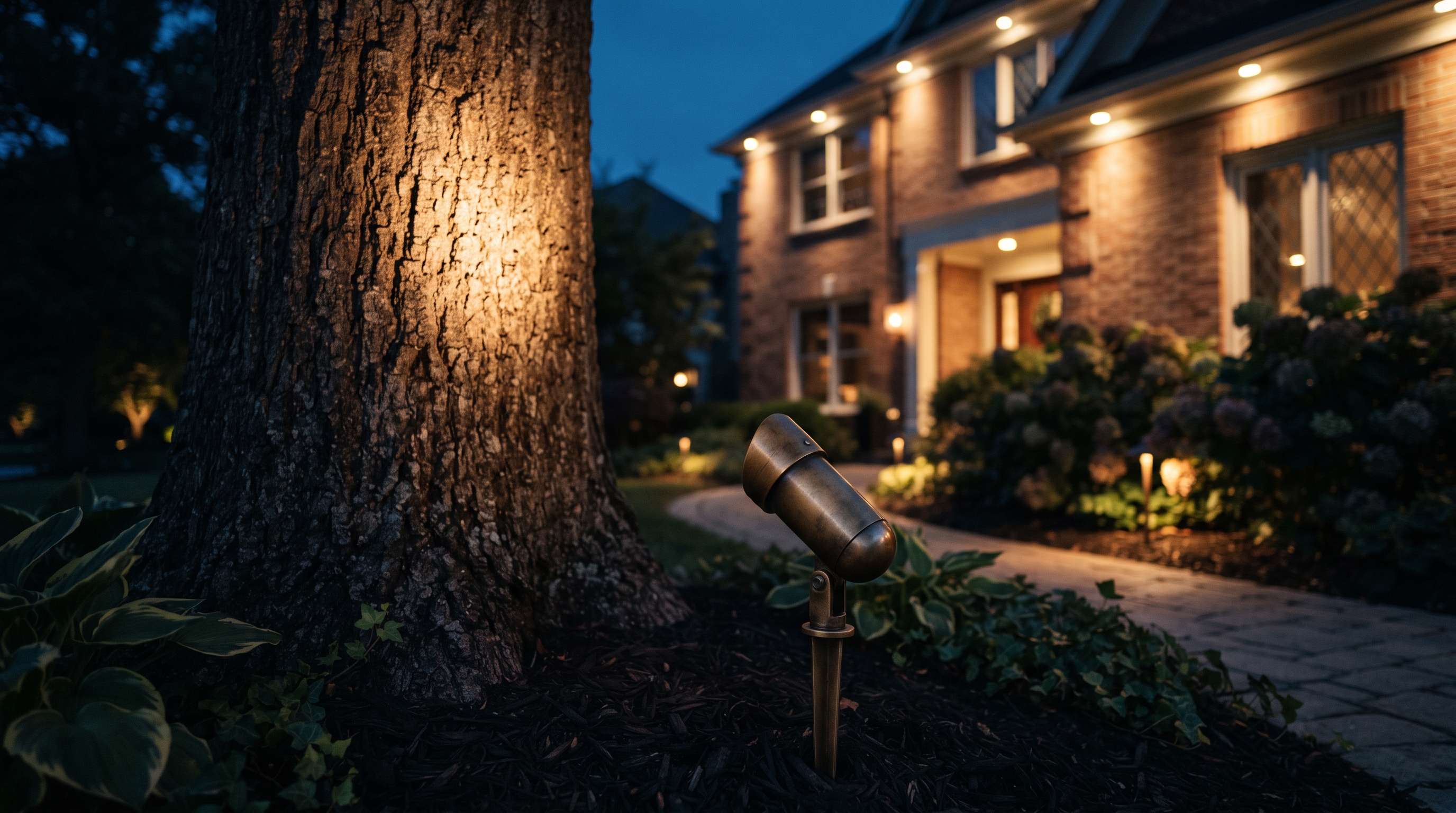
Fixture material is the single best predictor of whether a landscape lighting system still works in year ten. The LED lamp can be swapped. The transformer can be replaced. The fixture body is the part sitting in wet mulch, freezing solid in January, and taking a string trimmer hit every June. In Greater Cincinnati, that is what decides the lifespan of the whole system.
What are landscape lighting fixtures actually made of?
Almost every low-voltage landscape light sold in the Cincinnati market is built from one of four materials: solid cast brass, copper, aluminum, or plastic composite. The lamp inside is the same LED in all four. The housing is what changes.
- Solid cast brass. Heavy, machined, no coating. It oxidizes to a soft brown patina and stops there. Nothing underneath is rusting.
- Copper. Same corrosion behavior as brass, softer metal, weathers to a deeper brown and eventually a green verdigris on some alloys. Common on well lights and hardscape fixtures.
- Aluminum. Cast or extruded, then powder-coated black or bronze. The coating is the only thing between the metal and the soil.
- Composite. Molded plastic or a plastic-and-resin blend, sometimes with a metal-look finish. This is what almost every big-box kit ships.
A quick field test: pick the fixture up. A solid brass bullet spotlight has real weight to it. An aluminum or composite fixture of the same size feels close to empty.
Why does fixture material matter more in Cincinnati than in a mild climate?
Because our ground freezes and thaws repeatedly all winter instead of freezing once and staying frozen. Southwest Ohio runs through dozens of freeze-thaw cycles between November and March. Each one is a small hydraulic event: water works into a seam or a lens gasket, freezes, expands, and pushes the joint open a fraction of a millimeter. Then it thaws and more water gets in.
Brass and copper handle that because the metal itself is corrosion-resistant all the way through. Aluminum does not fail from the cold. It fails because the powder coat gets nicked at the ground stake or the mulch line, moisture reaches bare aluminum, and the metal oxidizes into a chalky white pitting that spreads under the coating. Add de-icing salt spray off driveways in Mason, West Chester, and Montgomery and that process speeds up.
Composite housings fail a third way. UV exposure over a few summers makes the plastic brittle, and a brittle fixture cracks the first time a mower deck or trimmer line clips it.
How long do brass, copper, aluminum, and composite fixtures last here?
In this climate, solid brass and copper run 20 or more years, aluminum runs 7 to 10, and composite runs 2 to 5. Those are the numbers we see pulling failed systems out of the ground across Greater Cincinnati, and they line up with what the manufacturers warranty.
- Brass and copper: 20+ years. The failure mode is usually the socket or the gasket, both of which we replace in the field for a fraction of a new fixture.
- Aluminum: 7 to 10 years. First visible failure is white oxidation at the stake, then a pitted housing, then water intrusion at the lens.
- Composite: 2 to 5 years. Cracked housings and clouded lenses, usually starting in the third summer.
That spread is the entire argument. A composite front-yard system installed in 2026 gets replaced twice before a brass system installed the same week needs its first lamp change.
What does brass cost compared to aluminum in the Cincinnati market?
Cast brass and copper fixtures cost roughly 3 to 5 times what aluminum or composite fixtures cost, and they last 4 to 6 times as long here. Mid-tier powder-coated aluminum lands around $200 to $350 per installed fixture in our market. Professional brass and copper runs higher per fixture and is what carries our full-property systems.
Run the math over 20 years instead of over the quote. A 20-fixture aluminum system replaced at year 9 costs more in total than the brass system did on day one, and that ignores the labor of digging the beds back up and the two seasons of dim, half-dead lighting that precede a replacement. Our 2026 Cincinnati outdoor lighting cost guide breaks the full pricing tiers down by system size.
When a quote comes in far below the rest of the field for the same fixture count, the fixture metal is almost always where the savings came from. Ask what the housings are made of before you compare the numbers.
Does a lifetime fixture warranty actually mean anything?
It means something only if the company that wrote it is still local, still answering the phone, and willing to come dig. A lifetime warranty on a composite fixture from a manufacturer that ships you a replacement housing in a box does not cover the two hours of labor to pull the old one, redo the connection, and re-aim the beam.
Three questions worth asking any Cincinnati installer before you sign:
- Does the warranty cover the labor to install the replacement, or only the part?
- Is the warranty from you, or from a manufacturer I have to file with myself?
- If I call you in year seven with three dead fixtures, do you come out?
We answer that last one the same way every time, including on systems we did not install. Most companies here only sell new installs and will not troubleshoot someone else another crew put in the ground five years ago. That is the gap we built the maintenance and repair side of the business around.
When is aluminum or composite the right call?
Aluminum makes sense on a starter system, a rental property, or a zone you expect to redesign within a decade. If the budget forces a choice between 10 aluminum fixtures now and waiting two years for 10 brass, lighting the house now with aluminum and a properly sized transformer is a defensible decision.
The part not to compromise on is what is underground. A correctly sized multi-tap transformer, heavy-enough wire for the run length, and waterproof grease-filled connectors cost the same whether the fixtures above them are brass or aluminum. Get that layer right and upgrading fixtures later is a same-day swap. Get it wrong and the whole system comes back out.
Composite is the one we steer people away from in this climate. It is the material we pull out of yards most often, and it is rarely worth the labor to replace one piece at a time.
Can you replace failed aluminum fixtures without redoing the whole system?
Yes, in most cases. If the wire runs, connectors, and transformer are sound, individual fixtures swap onto the existing system one at a time. We do this constantly: a homeowner in Loveland or Anderson Township has a 9-year-old aluminum system where six of 22 fixtures have corroded through, and we replace those six in brass and leave the rest until they fail.
What forces a full redo is the buried layer. Twist-on wire nuts instead of waterproof connectors, undersized 12AWG wire on a 150-foot back-yard run, or a maxed-out single-tap transformer all mean the new fixtures will underperform no matter what they are made of. We test voltage at the fixture before quoting a swap so you know which situation you are in.
How do you check what is already in your yard?
Walk the beds after dark with a flashlight and look at three things on each fixture.
- The stake and the base. White chalky powder or pitting means aluminum that is already corroding. Uniform brown means brass doing exactly what brass does.
- The lens. Fogging or condensation inside means the gasket has lost its seal and water is in the housing.
- The weight. Loosen one from the stake. If it feels hollow, it is aluminum or composite.
If most of the yard shows white oxidation and a couple of fixtures are already dark, you are at the front edge of a replacement cycle, not a repair. Late August through October is the right window to handle it, while the ground is workable and before the early-dark evenings make the gaps obvious every night.
We serve Maineville, Mason, West Chester, Loveland, Montgomery, Indian Hill, Hyde Park, and Anderson Township. Call (513) 828-8501 or request a free estimate and we will tell you what is in your beds and what it will take to make it last.
Want a property like the ones in this post?
Free on-site consultation across Greater Cincinnati.
Schedule a Free Estimate